Curriculum
Overview
The humanities program provides an organic study of Western Civilization, written and oral communication, classical and modern languages, Mathematics, and Natural Sciences, providing the student with a broad general culture and specialization in Humanities.
The following diagram illustrates the complete layout of the academic program by subjects offered according to the current academic year:

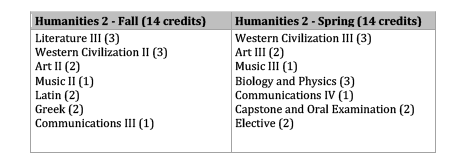
The following table presents the humanities program as designed from this year onward in a condensed synopsis. Only this year, the second-year students will follow a transitional curriculum; see below.
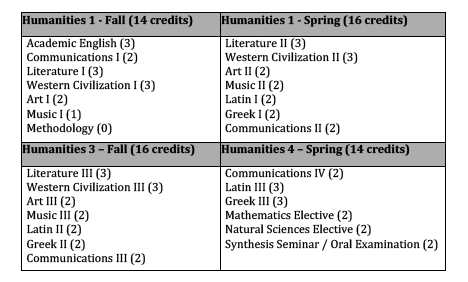
Transitional curriculum for second-year students during the 2026-2027 school year:
Course Descriptions
Humanties
Academic English is a three-level course designed to strengthen the students’ mastery of the English language within the context of humanistic studies. Students are placed in beginning, intermediate, or proficient sections according to their demonstrated level of English, with each section pursuing the same academic objectives through instruction appropriate to the student’s proficiency. The course places particular emphasis on the development of academic writing through the study and practice of composition, while also fostering careful reading, vocabulary development, grammatical accuracy, and effective written expression. As students advance, they engage in increasingly sophisticated analysis of texts, including selected works of English literature and poetry, using them as models for critical reading, interpretation, and academic writing. Throughout all three levels, the course seeks to cultivate precision of language, clarity of thought, and excellence in written communication. Taught by Fr. John Pietropoali LC, Fr. Junior Santos LC and assisted by Mr. Elijah McLellan.
This course is designed as an introduction to the basic concepts of art history, and to its development from Antiquity up through the High Middle Ages. While the history of art will be presented in chronological progression, common underlying aesthetic and ideological principles are identified and reflected upon in order to evaluate and appreciate better the patrimony and the impact which the visual arts has exerted on man. In particular, for painting, sculpture, and architecture, the following periods are studied: Pre-History, Ancient Near East, Egypt, Crete, Mycenae, Greece, Rome, early Christianity, Byzantium, Pre-Romanesque, Romanesque and Gothic. Each period and artistic style is placed within the socio-cultural context of the epoch, emphasizing underlying ideas and beliefs. The most representative works of art from each period are presented along with references to primary texts about art and aesthetics. The course format will include both lecture and more in-depth discussion of a select few of the most representative artworks along with references to primary texts about art and aesthetics. This course will also emphasize, through reflection and discussion, historical artworks in relation to contemporary cultural issues as well as their potential for application as tools of apostolate. Guided visits to the following art museums will provide firsthand experience of the material covered in class: The Yale Art Gallery; The Museum of Russian Icons; The Worcester Art Museum; and the Metropolitan Museum of Art, New York. Taught by Mrs. Louise Joyner.
This course builds upon that covered in its prerequisite, Art History I, as it continues the socio-historical presentation of painting, sculpture, and architecture during the Renaissance, Mannerist, Baroque, Rococo, and Neo-Classical periods. The most representative works of art from each period are presented along with references to primary texts about art and aesthetics. The course format will include both lecture and more in-depth discussion of a select few of the most representative artists and their artworks. “Mock Virtual Tours” will offer an opportunity to simulate the experience of presenting a guided tour in the context of an art museum, a church or an artistic landmark. Guided visits to: The Boston Museum of Fine Art; The Metropolitan Museum of Art, New York; The Frick Collection, New York; and The Hispanic Museum and Library, NY, will provide firsthand experience of the material covered in class. Taught by Mrs. Louise Joyner.
This course, following upon prerequisites Art History I & II, concludes the socio-historical survey of art history with a variety of modern and post-modern movements from the nineteenth and twentieth-centuries up to present-day contemporary art. Some of the key art historical movements that will be studied include: Romanticism, Realism, Impressionism, Expressionism, Futurism, Cubism, Surrealism, Pop Art, and Post-Modernism. The course format will include both lecture and more in-depth discussion of a select few of the most representative artists and their artworks. The leitmotif for the survey of modern art will be an emphasis on aesthetics, art theory and criticism, that is, an introductory overview of art historical methodologies and aesthetics, that is, the philosophy of beauty. As in the prerequisite art courses (Art History I and II) this course will continue to emphasize, through reflection and discussion, the artworks in relation to contemporary cultural issues as well as their potential for application as tools of apostolate. “Mock exhibitions” will offer the opportunity to travel back in time through role playing the parts of artists and critics at various exhibitions and events from the late nineteenth century to the present. An architectural walking tour of New Haven and visits to the following art museums will provide firsthand experience of the theoretical principles and the historical overview provided through lecture and discussion covered in class: The Wadsworth Atheneum, Hartford; Museum of Modern Art, NY; and a walking architectural tour of New Haven. Taught by Mrs. Louise Joyner.
In this course, students read, analyze and discuss selected works from classical authors. The authors or themes treated are as follows: introduction to Greek Literature, Homer, Hesiod, Lyric Poets, Greek Tragedy, Lucretius, Virgil, Horace, Ovid, Catullus, Early Medieval Epics (from Beowulf to the Nibelungenlied) Dante, Petrarch, Chaucer, Spenser, Shakespeare, Milton, Cervantes, the Spanish Golden Century, French Theater, Jonathan Swift. A weekly seminar period is dedicated to Virgil’s Aeneid, with students reading the entire work and preparing a presentation on a specific topic. A discussion of major themes and topics—such as literary devices, ideas and intuitions regarding human nature—follows each presentation. Taught by Dr. Baltazar López.
This course entails reading, analysis, and discussion of selected works from the nineteenth century. The authors or themes treated are as follows: Goethe, Romanticism in England, Spain, and Italy, Realism and later literary movements. For the seminar, students will go deeper into Dante and his Divine Comedy. They prepare different presentations throughout the semester with the help of various commentaries and under the modality suggested by each seminar director. Taught by Mr. Baltazar López.
This course entails the reading, analysis, and discussion of selected works from the twentieth century, such as Wilde, Kafka, Hawthorne, Melville, Twain, Hesse, Hemingway, Tolkien, Lewis, García Márquez, Borges, Paz and others. Taught by Dr. Baltazar López.
This course is the first part of a three-semester survey of the history of European art music from Greco-Roman antiquity to the twentieth century. The course opens with a general, basic introduction to music theory, including consideration of music’s aesthetic and ethical dimensions. The course then begins the survey, covering topics and composers such as Mesomedes of Crete, Gregorian chant, the beginnings of polyphony in the Middle Ages, and liturgical and secular music of the Renaissance. Concerts and other special events will be part of the program. Taught by Dr. Charles Mercier.
This course is a continuation of Music History, covering seventeenth and eighteenth century European art music, the Baroque and Classical periods. Included will be topics and composers such as Sweelinck, Pachelbel, Bach, Handel, Mozart, and Beethoven, the development of opera, Bach’s Well-Tempered Clavier, and sonata form. Concerts and other special events will be part of the program. Taught by Dr. Charles Mercier.
This course is a continuation of Music History, covering nineteenth and twentieth century European art music, the Romantic and modern periods. Included will be topics and composers such as Chopin, Schumann, Brahms, Wagner, Debussy, Schoenberg, Messiaen, and Glass, nationalism, atonality, and minimalism. Concerts and other special events will be part of the program. Taught by Dr. Charles Mercier.
This course entails the reading, analysis, and discussion of selected works written in Spanish, with an emphasis on the twentieth century. Some of the authors to be covered in the course are Rubén Darío, Antonio Machado, Miguel de Unamuno, Octavio Paz, Gerardo Diego, Juan Ramón Jiménez, Miguel Delibes, Jorge Luis Borges, Gabriel García Márquez, Mónica Ojeda, among others. Taught by Dr. Baltazar López.
This course stresses the connection between philosophy and literature; it shows how they intertwine, how one discipline draws from the other, and how the exchange between them is mutually enriching. At the same time, it highlights the distinctions between philosophy and literature and the different methods they employ to approach their respective objects, where there is a significant, if not total, overlap. The course will examine the lives and works of Plato, Aristotle, St. Augustine, St. Thomas Aquinas, St. Bonaventure, Descartes, Spinoza, Pascal, Locke, Kant, Hegel, Kierkegaard, Schopenhauer, Nietzsche, Heidegger, Sartre, and others. Taught by Dr. Baltazar López.
This course will study composers, genres, and themes not represented in Music History I-III or ones that were represented but in greater depth. Topics may include Renaissance, Baroque, and Classical liturgical music, Catholic and Lutheran; opera and ballet; and English and American music. Taught by Dr. Charles Mercier.
Social Sciences
This course is a workshop. It includes analysis of models, individual and team exercises, and peer evaluation. Students also learn how to reframe hot-button issues to foster constructive dialogue Taught by Fr. John Pietropaoli LC and assisted by Mr. Elijah McLellan .
In this basic story course, we study the universal tools of story. This includes, the importance of opposites, creating a complex character, writing good dialogue, show-don’t-tell, forces of antagonism, foreshadowing, and backstory. We will see these tools used in movie clips and then each student will write the script and create a short video with 2 characters. The student will act in the video as both characters. Taught by Patrick Langan LC.
In the basic story course of the second semester, we studied story tools as communications tools. Now we will see these same tools as thinking tools, just like a detective does when he is trying to solve a crime and is building his storyline. We will see these tools applied in G. K. Chesterton’s detective, Fr Brown. The course is relevant in a world with so many conflicting narratives. How do you begin to know which is true? The answer is thinking like a detective. Taught by Fr. Patrick Langan LC.
This course is a workshop where students can put into practice much of the theory learned in the previous semesters. Taught by Fr. John Pietropaoli LC and assisted by Mr. Elijah McLellan .
This course intends to highlight important aspects that arise within cultures and peoples from ancient cultures down through the end of the early Middle Ages. In the lecture classes, special attention is paid to cultural development with regards to currents of thought in the philosophical, political, and economic fields and their effect on daily life and culture as a whole. Connections are drawn between socio-economic conditions and the progress of the arts and sciences, as well as their place in and effect on the social order. Furthermore, the course intends to provide patterns of judgment and understanding of the present political and cultural situation of the world in view of its roots and causes in previous periods. This course covers readings from early Mesopotamian Civilization to about 1050 A.D. Students are required to read primary sources on a variety of topics, formulate a thesis on each topic, and express that thesis in class discussion. Taught by Dr. Timothy Kearns.
This course will discuss themes and socio-cultural developments, predominantly of Western Europe, from the High Middle Ages (1100s) down to the mid-nineteenth century. The classes build on the historical account previously studied and analyze underlying questions with the help of source texts. Taught by Dr. Timothy Kearns.
This course will discuss themes and socio-cultural developments from around 1850 until the present day, such as nationalism, imperialism, and other dominant ideologies, the formation of the current global landscape in the aftermath of World War II, the cultural changes since the 1960s and the situation of the religion and the Catholic Church in particular during the twentieth century. Contemporary developments such as globalization, international organisms, and sociocultural trends will be studied together with their impact on the present. Students will be expected to explain briefly and succinctly each theme, the relationships between themes, and their connections to other cultural developments of the period. The classes build on the historical account previously studied and analyze underlying questions with the help of source texts. Taught by Fr. Andreas Kramarz LC.
Mathematics & Natural Sciences
Modern physics refers to physics developed in the twentieth century. Much of modern physics is concerned with the behavior of matter and energy under extreme conditions or on a very large (the universe) or very small (subatomic level) scale. This course is an introduction to a broad range of topics in Modern Physics. The course covers Special Relativity, Quantum Mechanics, Atomic Physics, Nuclear Physics, Particle Physics, and Cosmology. Taught by Dr. Timothy Kearns.
A grounding in the biological sciences is necessary for a reasoned discussion of topics in bioethics, especially reproduction, abortion, euthanasia, brain death, advanced medical treatments, evolution, and ecology. This course will present an overview of biological science, with an emphasis on those topics which relate to these bioethical issues for human beings. The goals are to understand general biological principles in humans, including embryology, cells, tissues, and organ systems, and endocrinology, understand how bioethical decisions are made in medical practice; understand the principles underlying evolution, how they are evaluated and understand ecological systems and how human activity impacts the environment. Taught by Dr. Gary Tennyson.
This Mathematical course is designed for the Humanities student to appreciate the role of mathematical reasoning, the history and development of mathematical ideas, and the relation Mathematics has to the Sciences. It will cover the following topics: the greatest Mathematicians in history: history of Mathematics, a view of the world: method of Mathematics and Logic (exercises), mathematical conviction: proofs (the most famous and classical proof – Pythagoras, Euclid, etc., types of proof, exercises), the secret of abstraction: number theory (Arithmetic, exercises); learning to be concrete: The statistical method (exercises), Archeology and Mathematics: numbers and geometry in Babylon and Egypt, the perception of reality through Geometry: forms, their use in Biology, Art, Architecture, and more, there is something else: types of Geometry (Euclidean geometry, Projective geometry, Riemannian geometry), Art and Mathematics (exercises), today’s Mathematics: Astronomy, Nature, Medicine, Computing, Telecommunications, etc. Taught by Dr. Timothy Kearns.
Languages
This course is a year-long course of readings in the Latin of the Catholic Church: liturgy, hymns, Vulgate, and ecclesiastical teaching and administrative documents. The course will presuppose elementary Latin morphology and syntax and will present more advanced Classical syntax for the first time. Taught by Dr. Charles Mercier.
This course is a continuation of L 201. Taught by Dr. Charles Mercier.
In this course, students will read Cicero’s Pro Archia, delivered in 62 AD, which is a masterpiece of ancient rhetoric that poses a legal issue limited enough for students to get a good grasp of and evaluate, and which also contains an influential passage on the value of the liberal arts. Students will read the oration together, construing the Latin carefully, paying attention to Ciceronian techniques of rhetorical artistry, and considering the speech’s discussion of the value of humanities study. The course will presuppose familiarity with Classical Latin syntax, but will provide review as necessary. Taught by Dr. Charles Mercier
In this course, students will do readings from the Epistulae Morales of Seneca with consideration for his Stoic thought, particularly as it may be consonant with Christian moral teaching. Students will also read other writers of the empire, including Pliny, Tacitus, Petronius, and St. Augustine, drawing from his sermons and Biblical commentaries, as found in the Office of Readings. The two semesters together will emphasize the techniques and practice of Classical rhetoric and the development of Latin prose style. Taught by Dr. Charles Mercier.
In this course, students will read readings from Fathers of the Church, who defended and explained the faith in times of persecution and establishment, controversy and peace, over the first seven centuries of Christianity. Selections from Christian authors such as Tertullian, Ambrose, and Jerome, who wrote in Latin in the Western Empire in a variety of times and circumstances. Choice of readings can reflect particular interests of class members. Taught by Dr. Charles Mercier.
This Greek course is the continuation of Greek 102. In the previous course, the student became familiarized with a wide range of vocabulary and the most common tenses and modes in Biblical Greek following the method Χριστὸς Κύριος. In this course, the student will become familiarized with St. Paul’s epistle to the Romans and some other Greek texts (mostly from the New Testament without excluding other possibilities); this will be up to each student’s preference. Taught by Dr. Charles Mercier.
This course is a continuation of Greek 201. In it the students will continue the study of the Method Christos Kyrios. It presupposes the previous chapters have been sufficiently assimilated and it will continue to build upon these foundations. This course will continue to expand the students’ vocabulary and their understanding of the New Testament grammar and syntax. Taught by Dr. Baltazar López.
This course is a continuation of Greek 202. The students will continue the study of the Method Christos Kyrios. It presupposes the previous chapters have been sufficiently assimilated and it will continue to build upon these foundations. In addition, the students will also have the possibility to explore some texts of the New Testament and realize the particularities of the Greek text. Taught by Dr. Charles Mercier.
This course is a continuation of Greek 301. The students will become familiarized with the books of the New Testament in their general structure and in their particularities (vocabulary, most common constructions, and writing style). This course is also open to exploring other Church documents such as the Septuagint or the sermons and treatises of the Church Fathers. In this way, the students will expand their horizons and their understanding of the Koiné Greek as it was used in the first centuries A.D. Taught by Dr. Charles Mercier.
This is a course on Greek tragedy. It presupposes that the contents of the previous Greek courses have been sufficiently assimilated. The students will become familiar with the Greek play Medea by Euripides. Besides becoming familiar with some of the traits of Athenian culture and politics during the fifth century B.C., the students will also have the opportunity to delve into the Greek text of numerous passages of the play. In this way, he will form his sensitivity to literary and human values. In addition, the students are expected to explore other great works of ancient Greek literature, especially the works of Aeschylus, Sophocles, and Euripides himself. This does not prevent the student from exploring other great authors of ancient Greece, such as Homer, Hesiod, Aristophanes, Demosthenes, etc. Taught by Dr. Charles Mercier.
The course can be arranged as a supplement to a two-credit Greek or Latin language course or on a topic on its own. Possibilities include reading an extra work or author or exploring a theme in Classical studies or an inter-disciplinary interest that includes Classics. Directed by Dr. Charles Mercier.
Students will study readings and communicate an ancient sermon. Members of the course will read and master a Patristic sermon this year in Greek, practice delivering it aloud, and then collaborate in the production of a youtube video to communicate an experience of the sermon in its original language to the wider world. Taught by Dr. Charles Mercier.
These courses, differing according to the level of pre-existing knowledge, are designed to bring non-native English speakers who arrive for the first year of the program to a college level of English. They take place before the beginning of the first semester.
This course is designed for non-native English speakers who arrive for the first year of the program and need to continue strengthening their English proficiency.