
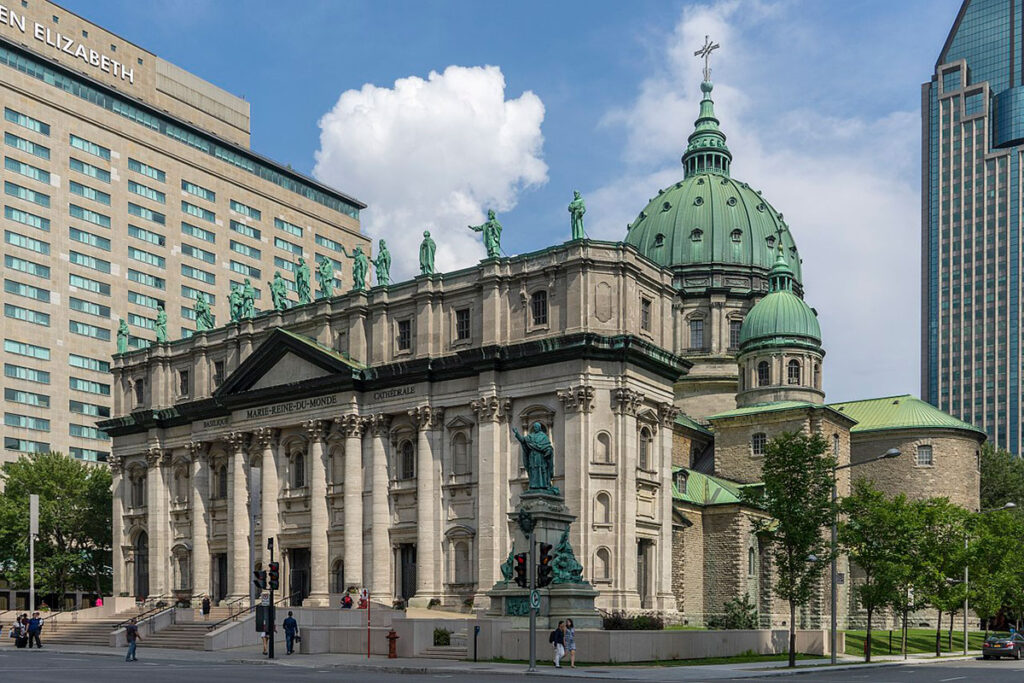
 “Architecture is the built form of ideas” and “church architecture is the built form of theology” (McNamara, Catholic Church Architecture and the Spirit of the Liturgy, p. 3). Throughout history the Church has influenced secular architecture and culture. In the past century due to the effects of secularisation a shift happened where the Church now follows the trends of the world in their architecture. This is exemplified in the comparison between two churches. The first is the Basilica-Cathedral of Mary Queen of the World in Montreal, Quebec from 1894. It is a baroque revival cathedral, designed by Victor Bougreau and patronized by Monseigneur Ignace Bourchet, which is made of limestone and copper that towers over the old city. The second is the Cathedral of the Holy Family, a modernist cathedral in Saskatoon, Saskatchewan finished in 2011. It was designed by Friggstad Downing Henry Architects, patronized by the Diocese of Saskatoon, and is located in the northeast end of Saskatoon. It is made out of concrete, steel, and features solar panel stained glass windows. By looking at the scriptural foundations that reveal God’s plan for the Church; the classical tradition that provides a language to communicate ideas clearly and unambiguously; and the high altar of the two churches; it is evident that the secularization of churches is problematic because it strays from revelation, interrupts the clear communication of theology which architecture should provide, and fails to give orthodox liturgical hierarchy to the church.
First, Church architecture as the built form of theology must be in accord with the tradition of the Catholic Church. The tradition and theology of the Catholic Church is best found in the scriptural foundations where God reveals himself to man. A key scriptural image is the temple of Solomon. Within Solomon’s temple, various features stood out such as the holy of holies, which “was understood as a ‘copy’ of the heavenly sanctuary” (McNamara, Catholic Church Architecture and the Spirit of the Liturgy, p. 55); the garden which was “the place where humanity and God met” (McNamara, Catholic Church Architecture and the Spirit of the Liturgy, p. 49); and the tabernacle, “a semipermanent tent-like structure” (McNamara, Catholic Church Architecture and the Spirit of the Liturgy, p. 42). Thus for a church to be faithful to Tradition, it should incorporate these types into its design.
In Montreal’s cathedral we see all the aspects of the holy of holies, the garden, and the tent. The holy of holies is a clear, elevated separation in the cathedral marked by the altar rail that separates the sanctuary from the rest of the church (fig. 1). This shows that “the architecture in which God dwells and represents his presence on earth deserves to be a place of a higher dignity than that of the secular realm” (McNamara, Catholic Church Architecture and the Spirit of the Liturgy, p. 44). The garden is present in the floral ornamentation on the corinthian columns that support the church, and the floral ceiling coffers (fig. 2). This clearly communicates God’s
“desire to reunite himself with his creation … [inviting] humanity back into the garden” (McNamara, Catholic Church Architecture and the Spirit of the Liturgy, p. 49). The tabernacle is evident in the tent-like baldacchino that stands over the high altar and tabernacle, the place of God’s true presence (fig. 3). This structure is permanent, and through its permanence represents the presence of the Lord who will “be with us until the end of the age” (Stroik, The Church Building as a Sacred Place, p. 33).
Saskatoon’s cathedral fails to represent the scriptural types used in church architecture. Its round plan makes no distinction between the congregation and the celebrant, thus giving no sense of the holy of holies (fig. 4). The sanctuary is slightly elevated and there is no altar rail. It is also stripped of any ornamentation and completely bare of anything signifying the Garden of Eden. There is neither a tester nor a baldachino above the sanctuary, and the tabernacle is nowhere to be found.
Second, the architecture needs to have a clear language that can clearly and unambiguously communicate right doctrine. The foundation for the meaning of architecture is found in the classical architect Vitruvius. He conceives of architecture as “some sort of invisible idea from the mind of the architect, and … a tangible building which signifies this idea” (McNamara, Catholic Church Architecture and the Spirit of the Liturgy, p. 83). Since church architecture has grown out of this tradition the significance of these classical elements that the church has used for two millennia to express her theology must be considered. In order to clearly communicate theology, architecture has developed this language “composed of recognizable conventions capable of expressing both the most grand and most subtle statements” (McNamara, Catholic Church Architecture and the Spirit of the Liturgy, p. 86). This language “follows the patterns in nature set by its creator” and uses “ornament to represent clarity of purpose, and decoration to express clarity of structure” (McNamara, Catholic Church Architecture and the Spirit of the Liturgy, p. 89).
Montreal’s cathedral uses the classical language to communicate its theology. Some notable aspects of reality are visible in the columns with entasis which shows gravity’s
“downward force on buildings” (McNamara, Catholic Church Architecture and the Spirit of the Liturgy, p. 92). Another important aspect is ornamentation which speaks of the purpose of the building. In Montreal it is present in the gold writing on the facade and interior (Fig. 2). There are also statues of the saints along the pediment of the facade, indicating the communion of saints; and the insignia of the Cardinal-Bishop of Montreal is on the base of the dome, signifying the importance of the cathedral (Figs. 5, 6). There are further relief sculptures ornamenting the bottom of the dome with bowls of overflowing bread and grapes, signifying the eucharist (fig. 7). The church is decorated in order to provide “elevated expression of the forces found in a building” (McNamara, Catholic Church Architecture and the Spirit of the Liturgy, p. 92). Not only to express the natural forces, but to show the dignity of the building for which they are being employed. In Montreal this is present in the dentils and modillions around the church, as well as the ornamented arches.
Contrariwise, the cathedral in Saskatoon is devoid of classical elements. Its exterior architecture consists of lines that contradict each other and show no rational order (fig. 8). There is little use of ornamentation. The sole symbol present is a cross on the roof outside. On the interior there is another cross without a corpus at the back of the sanctuary (fig. 9). The stained glass windows are abstract and do not clearly indicate anything related to the purpose of the building. It is devoid of decoration and the steel beams that hold up the roof are plainly exposed on the interior, hence there is no indication of the dignity of the building.
Third, the altar is “the church’s raison d’etre” (Stroik, The Church Building as a Sacred Place, p. 19). Thus it should hold pride of place in the church. Montreal’s cathedral has a sanctuary set apart for the altar which holds a central place and is elevated above all other liturgical furnishings. It has a baldachino to give it further emphasis in the sanctuary. This allows for the nave, and the rest of the church, to be “oriented toward the sanctuary and its center, the altar” (Stroik, The Church Building as a Sacred Place, p. 27). Its ambo is also located in the sanctuary “within a defined area and raised up” (Stroik, The Church Building as a Sacred Place, p. 29), but does not distract from the altar which holds the central place. The altar in Saskatoon’s cathedral is off-center in the sanctuary (fig. 9). It has no centrality within the church itself, which is lacking a clear nave or hierarchy that might bring the eyes of the faithful to rest on the altar. There is also an ambo, but it is on the same level of the altar and parallel to it in the sanctuary, which gives no hierarchy to the liturgy of the word and the liturgy of the eucharist.
To conclude, comparing the two cathedrals shows that traditional church architecture accomplishes something that modernist architecture cannot. Firstly, modernist architecture fails to follow the scriptural foundations upon which all theology is based while Traditional architecture fulfills the types found in the Old Testament. Secondly, modernist architecture fails to communicate theology through its building with clarity and distinction, while traditional architecture is able to clearly communicate ideas about theology because it speaks a universal language founded in reality and clear imagery. Stroik rhetorically asks, should not “The Catholic Church … be building the most avant-garde architecture of its day, just as it always has?” (Stroik, The Church Building as a Sacred Place, p. 63). I agree because before secularization that came with the end of the eighteenth century, “the Church formed Christian artists and architects who in turn influenced the architecture of the secular realm” (Stroik, The Church Building as a Sacred Place, p. 63). This automatically put the Church at the avant-garde of culture, while holding to the faith as is seen in Montreal’s cathedral. Since the mass secularization, “the Church has been following the lead of the secular culture and architects” (Stroik, The Church Building as a Sacred Place, p. 63), evident in Saskatoon’s cathedral which was designed by a purely secular company according to modernist principles. The Church is not called to sacrifice the faith in order to keep up with the world. To build in the modernist style means, to a certain extent, to commit architectural apostasy and is a lack of fidelity to the God who has revealed himself to us and saved us in Jesus Christ.